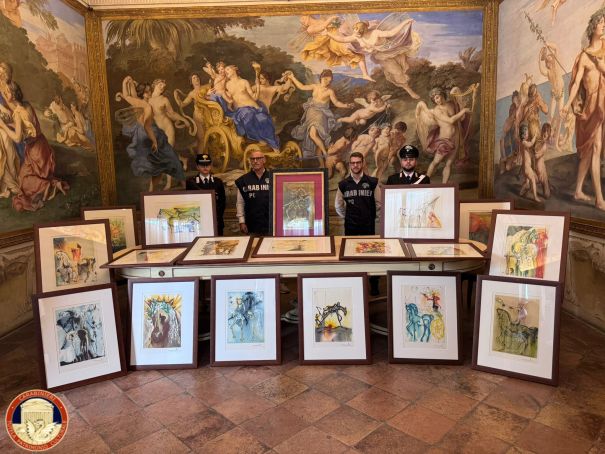
Every time a Salvador Dalí forgery scandal hits the news, like the recent bust in Italy where police seized 21 fake works in Parma, we get a strange sense of déjà vu. The Dalí print market has long been a rabbit hole where fact and fantasy blur, and this latest case just confirms why at Robin Rile Fine Art we focus on Dalí’s original paintings, drawings, and sculptures… But steer clear of his prints.
The Italian Bust: Déjà Vu in Parma
Earlier this month, Italian investigators confiscated 21 works attributed to Dalí, allegedly being peddled to collectors as authentic. While many works in the exhibition were accompanied by proper documentation, authorities reported that at least 21 pieces had “false authenticity certificates” attached, a telltale sign of how pervasive forgery schemes have become in the Dalí print market. According to prosecutors, the works were produced to look legitimate but had no connection to Dalí’s authorized print editions. The case mirrors countless others across Europe and the U.S. over the last four decades: opportunists preying on Dalí’s fame, flooding the market with fakes, and leaving collectors with little more than expensive wall décor and a cautionary tale.
Mett & Wiseman: Hawaii’s Dalí Factory
Back in the 1980s, two characters named William Mett and Marvin Wiseman turned the Dalí print market into something resembling a beachfront souvenir stand. Operating out of Center Art Galleries in Hawaii, they pumped out thousands of so-called “limited edition” Dalí prints. To the unsuspecting collector, they looked legitimate: certificates, signatures, fancy framing. In reality, many were unauthorized, mass-produced, and often of dubious quality. Their “factory” approach flooded the market with works that were as surreal as Dalí’s moustache, but far less valuable.
The Legend of the Blank Sheets
And then there are the infamous stories of Dalí signing blank sheets of paper in his later years. Whether fueled by declining health or questionable handlers, these blank pages later became the perfect canvas for opportunists: just add an image, voilà, a “Dalí” print. Imagine buying a signed “masterpiece” only to learn the artist’s sole contribution was his autograph, applied years before the picture even existed. It’s like buying a signed baseball from Babe Ruth… that turns out to be a blank baseball someone painted on afterward.
A Market Full of Minefields
Between these mass-productions, rumors, and outright fakes, the Dalí print market has been a magnet for controversy. Lawsuits have flown, collectors have been burned, and experts have spent decades trying to untangle the mess. Even reputable dealers can find themselves knee-deep in paperwork proving what isn’t a forgery.
Why We Stick to Originals
Dalí was a genius, but his genius lives most authentically in his original paintings, drawings, and sculptures, works created with his imagination and his eccentric brilliance. Prints, on the other hand, have too often been vehicles for exploitation. By focusing exclusively on originals, we ensure our collectors enjoy the authentic surrealism of Dalí, without the surreal headache of authentication battles.
The people who specialize in his prints are really good at it. But we know that’s not us. So, when you see headlines about the “latest Dalí forgery bust,” know this: it isn’t new. It’s part of a long, strange saga in which Dalí prints became the art world’s Wild West. And it’s exactly why we avoid the circus and prefer to let Dalí’s true legacy, his originals, speak for themselves.