

Andy Warhol (American, 1928–1987)
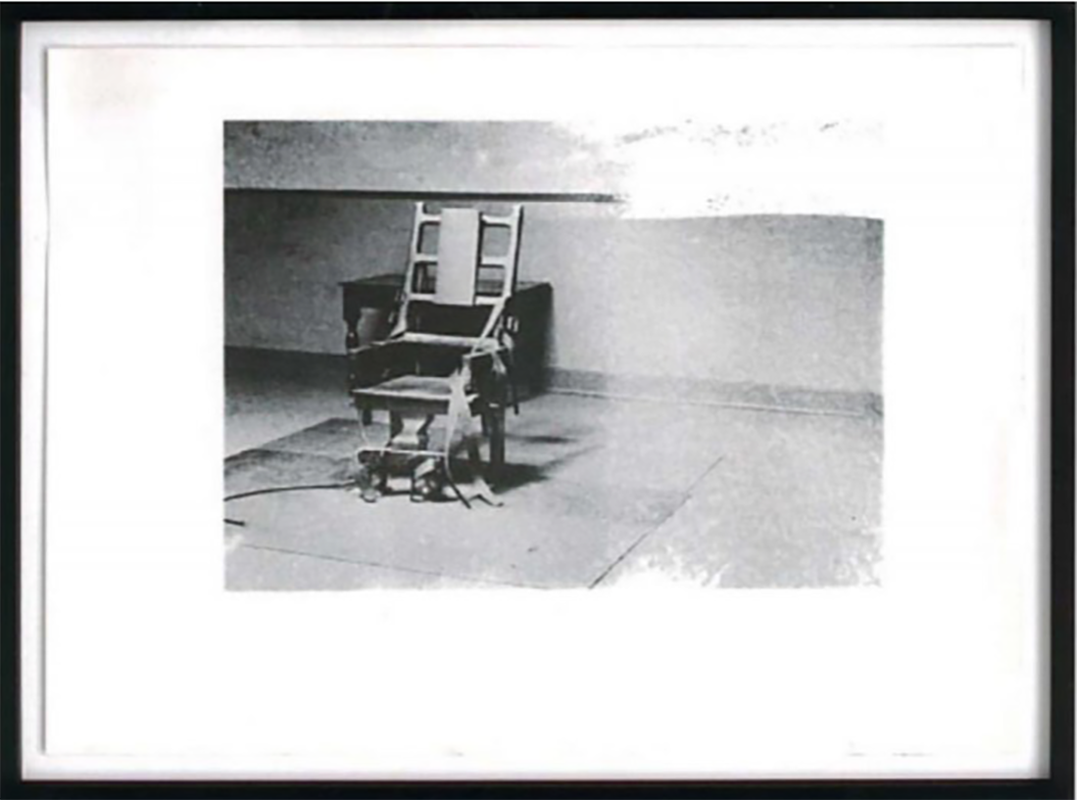
Electric Chair (Retrospective Series), 1978
Silkscreen on soft white wove paper
Sheet: 45.4 × 60.7 cm (17 7/8 × 23 7/8 in.)
Stamped verso with the Estate of Andy Warhol stamp and Andy Warhol Foundation for the Visual Arts stamp, numbered UP 47.49
Price: on request
About the Work
Andy Warhol’s Electric Chair is among the most provocative and immediately recognizable images of his career. First introduced in the early 1960s as part of his seminal Death and Disaster works, the subject transformed an empty execution chamber into a stark meditation on mortality, violence, mass media and American culture.
In this 1978 Retrospective Series interpretation, Warhol revisits the iconic composition in a dramatically reduced monochromatic vocabulary. The electric chair occupies an otherwise vacant institutional space, its isolation lending the image an eerie stillness. Rather than depicting violence itself, Warhol presents its aftermath—or perhaps its anticipation. The absence of a human figure becomes precisely what gives the image its psychological force.
The composition originated from a press photograph of the execution chamber at Sing Sing Prison in Ossining, New York, where the electric chair known as “Old Sparky” became one of the most notorious symbols of capital punishment in twentieth-century America. Warhol first appropriated the image in 1963 and returned to it repeatedly throughout his career, including the celebrated Little Electric Chair paintings and his 1971 portfolio of ten Electric Chair screenprints.
Warhol’s decision to revisit the image in the late 1970s is particularly compelling. By this stage, subjects originating in his radical 1960s work had become part of his own visual history. The Retrospective Series therefore operates on two levels: Warhol is appropriating mass-media imagery while simultaneously appropriating Warhol himself, reconsidering images that had already become synonymous with his career.
The present impression has an especially austere quality. Areas of photographic grain and tonal irregularity contrast with the large expanses of empty paper surrounding the image, giving the work an almost archival or documentary character. At approximately 24 inches wide, it also offers a particularly accessible scale for one of Warhol’s most historically significant subjects.
Stamped by both the Estate of Andy Warhol and the Andy Warhol Foundation for the Visual Arts, and numbered UP 47.49, this work offers collectors an opportunity to acquire one of Warhol’s defining images from the artist’s mature period at a price point substantially below that typically associated with his larger Electric Chair paintings and major editioned screenprints.