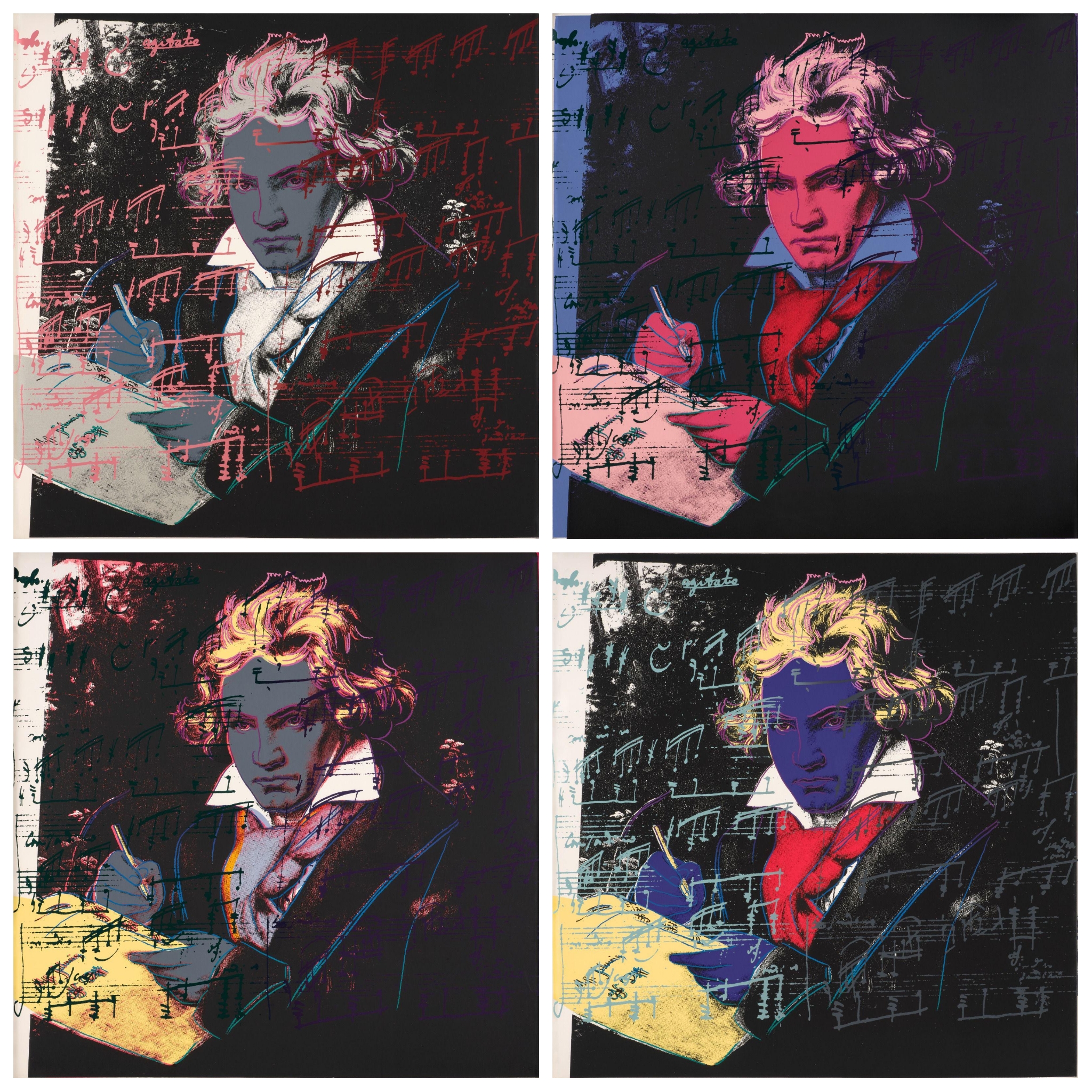

Andy Warhol (American, 1928–1987)
Beethoven, 1987
Complete portfolio of four screenprints in colors on Lenox Museum Board
40 × 40 in. (101.6 × 101.6 cm), each
Edition of 300, plus 30 artist’s proofs
Printed by Rupert Jasen Smith, New York
Published by Hermann Wünsche, Bonn
Feldman & Schellmann II.390–393
Complete matching-numbered set
Excellent condition
Price Upon Request
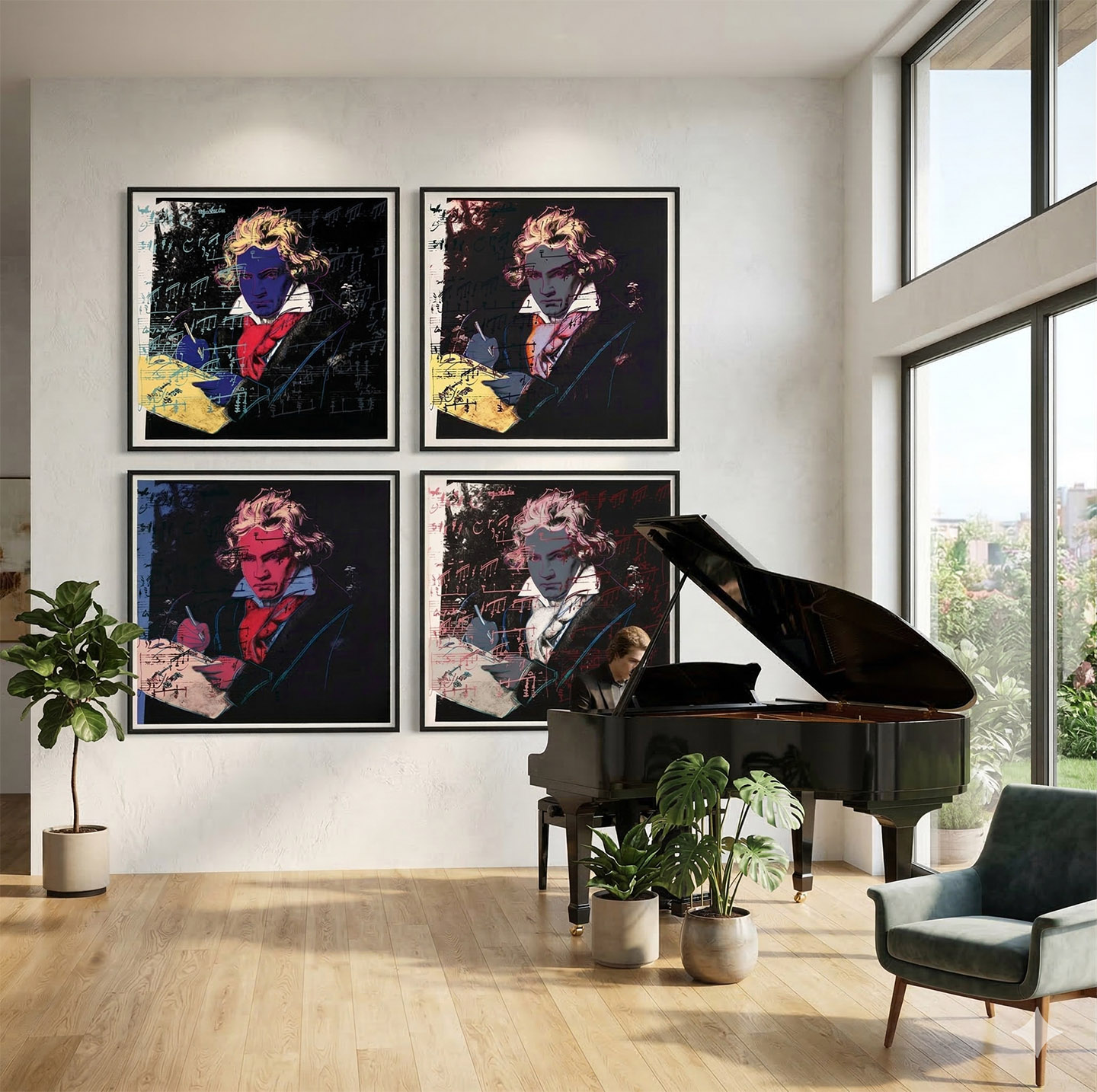
Created in the final year of Andy Warhol’s life, Beethoven represents a fascinating intersection of Pop Art, portraiture, and music. Rather than depicting one of the movie stars, musicians, or society figures so closely associated with his career, Warhol turned to Ludwig van Beethoven, transforming one of history’s most celebrated composers into a distinctly Warholian cultural icon.
The suite is based upon the famous 1820 portrait of Beethoven by Joseph Karl Stieler. Across the composer’s face and body, Warhol superimposed passages of handwritten musical notation from Beethoven’s work, creating an extraordinary visual interplay between the man and the music for which he became immortal.
Each of the four approximately 40-inch-square screenprints presents the same portrait through dramatically different combinations of saturated color. Viewed individually, each is a powerful late Warhol image; installed together, the four works become a rhythmic sequence of color and repetition—two ideas fundamental to Warhol’s practice and particularly appropriate to his musical subject.
There is also something wonderfully characteristic of Warhol in the choice of Beethoven. Throughout his career, Warhol explored the mechanisms through which individuals become icons. In Beethoven, that fascination extends beyond contemporary celebrity to a figure whose fame had already endured for more than a century. Warhol effectively places Beethoven alongside Marilyn Monroe, Elvis Presley, Mick Jagger, and his other famous subjects—recognizing cultural immortality itself as a form of celebrity.
Complete matching-numbered Beethoven portfolios are especially desirable, as many suites have been separated and the individual prints dispersed over time. Preserved as a complete set, the four works retain Warhol’s intended relationship between repetition, variation, color, and image.
This example is offered as a complete matching portfolio of all four works, Feldman & Schellmann II.390–393, in excellent condition.
Additional photographs, condition information, provenance, and pricing are available upon request.